


A national foresight exercise identifying the technologies that can transform the circular transition — and turning them into policy and investment priorities.
National foresight exercise, 2026–2027
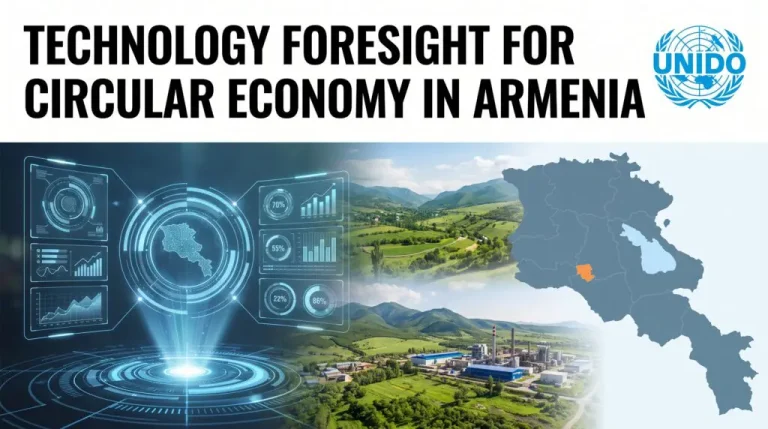
Through 2026 and 2027, Armenia is carrying out a technology foresight exercise on the circular economy. Its purpose is to identify the technologies with the greatest transformative potential for the country, and to establish what their adoption would actually require, over a horizon running to 2030 and 2035.
Foresight is not forecasting. It does not predict what will happen. It convenes the people who know a system well — in government, research, industry and civil society — and works systematically through what could happen, what the country would want to happen, and what has to be decided now for that outcome to remain possible.
The exercise is part of the EU4Green Recovery East programme, coordinated by UNIDO and run in parallel across several Eastern Partnership countries. In Armenia it is implemented by Civitta, with the Ministry of Environment as National Focal Point. Its results feed into national circular economy strategy planning.
What could plausibly happen to Armenia’s economy, resources and industry by 2035? National consultations build a set of scenarios and identify the one the country would most want to reach.
A national survey and an expert panel assess 20–30 candidate technology areas: which of them matter for Armenia, and what conditions their adoption here would require.
The findings become a sequenced roadmap of actions across immediate, 2030 and 2035 horizons, addressed to the institutions with the mandate to act on them.
The exercise depends on national participation, and it asks for two different levels of commitment.
A core group of 15–20 national experts carries the methodological work. Nomination involves four half-day panel rounds and both national surveys, between late 2026 and May 2027. Experts are nominated in consultation with UNIDO and the National Focal Points, and every invitee receives a written note setting out exactly what participation involves before accepting.
A wider pool of up to 100 organisations across government, research, business and civil society contributes through two national surveys. Each takes around 20 minutes. Every respondent receives the national summary report that their responses produce.
Contact the project teamThe exercise is funded by the European Union under the EU4Green Recovery East programme and coordinated by UNIDO. In Armenia it is implemented by Civitta, in cooperation with the Ministry of Environment as National Focal Point. The foresight methodology and analysis are led by UNIDO’s international experts; national consultation, engagement and reporting are led in-country.