What Really Works in Ukrainian EdTech: Insights from the Product-Market Fit Lab


The Ukrainian EdTech market is estimated to be worth approximately $500 million as of early 2026, with an annual growth rate of up to 25%. At the same time, EdTech companies in Ukraine operate in an environment of constant uncertainty and intense competition. Product-Market Fit has become the foundation for companies’ survival.
This was discussed by participants in the strategic lab “Product-Market Fit in Ukraine: Growth Strategies for EdTech Solutions”, organized by the EdTech Ukraine Association together with its partners.
The event brought together company founders, experts, and market practitioners in Kyiv to work with real-world hypotheses, products, and scaling strategies.
Speakers:

Natalia Lototska

Volodymyr Strashko

Roman Bozhok

Kateryna Severinko

Natalia Limonova

Liudmyla Melnyk
Workshop and practical
session were led by:

Olena Shershun

Oksana Kalenchenko
Product-Market Fit as a Prerequisite for Viability
EdTech in Ukraine is growing faster than both demand for educational technologies and the culture of using them. At the same time, competition is intensifying – Ukrainian players are competing not only with each other but also with global products entering our market. The winner is not the one who builds an interesting or even high-quality product, but the one who builds a product the market truly needs.
One of the main takeaways from the discussion is that Product-Market Fit in Ukraine is almost never a linear process. It is a constant search, testing, and adjustment of approaches.
“You have to constantly seek Product-Market Fit. It’s not a one-time exercise, but a process. You can no longer ‘perfect’ a product and lock it in. It needs to be constantly tested and adapted.”
Natalia Lototska
Other participants in the discussion supported this view: the market does not offer stability, but it does provide rapid feedback – and this is precisely what becomes a competitive advantage for those willing to adapt.
From Intuition to System
Another important shift is the transition from “gut feelings” to clear methodologies. Frameworks such as JTBD, ICP, and Value Proposition are becoming not just tools, but the foundation for decision-making.
Instead of asking “What does the customer want?”, participants propose a different approach: “Don’t ask the customer what they need – they don’t know themselves. Ask about their actual experience.”
Volodymyr Strashko
Acceleration as a Growth Driver
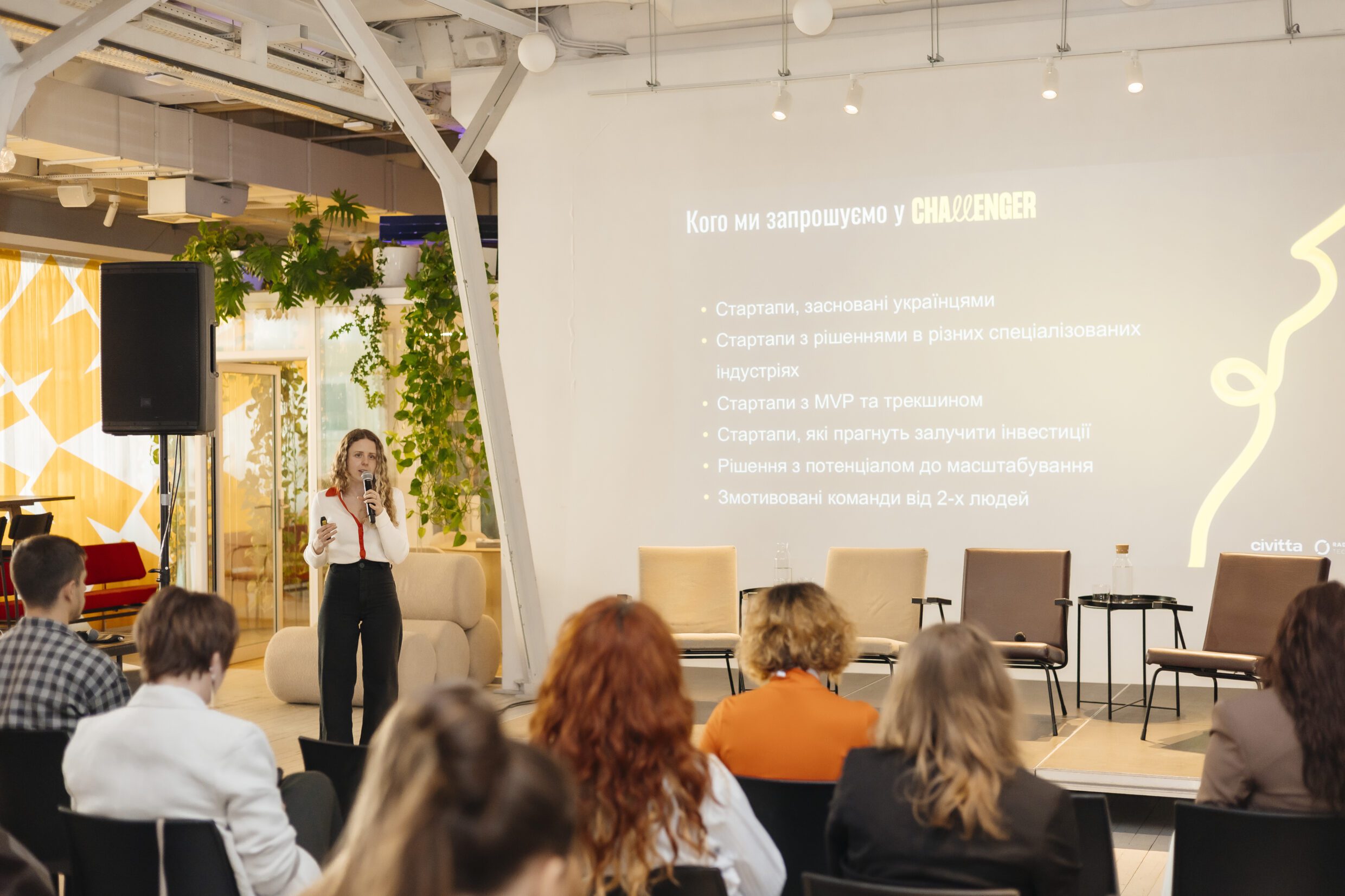
In 2025, Ukrainian startups raised $526 million in investments, with AI, SaaS, and EdTech remaining the key sectors. At the same time, as noted during a thematic workshop by Olena Shershun, Associate Partner at the consulting firm Civitta and Program Manager at Challenger Accelerator, grants remain one of the most effective sources of funding, and accelerators are often the most effective way to scale.
“The most beneficial funding source for startups is grants, and one of the most effective tools for startup development remains accelerator programs. Accelerators offer much more. They provide structure, speed, and market access”, the expert emphasized.
In fact, an accelerator becomes an environment where the product meets reality. There, it quickly becomes clear: what works, what doesn’t, what needs to be changed, and whether there is any potential for scaling at all. Sometimes this means radical changes to the product. But this is precisely what allows you to avoid greater losses in the future.
The role of accelerator programs in EdTech development goes beyond funding: they provide structure, mentorship, access to networks, investment readiness, and entry into international markets.
EdTech Ukraine & DOHE UK: Global Partnerships as a Path to Scaling
One of the key challenges facing Ukrainian EdTech companies is the limited size of the domestic market. In Ukraine, spending on education remains low, so most players are forced to look to international markets from the outset.
Natalia Limonova, Chair of the Board of the EdTech Ukraine Association and founder of GIOS, presented the EdTech Ukraine & DOHE UK accelerator as a tool for integrating Ukrainian companies into the global market.


The Go-Together Accelerator is implemented in partnership with the international organization DOHE Global, which operates at the intersection of education, innovation, and entrepreneurship and brings together startups, investors, and educational organizations to shape the future of education.
The accelerator’s selection process consists of several stages and combines Ukrainian and international expertise.
As a result, an international cohort of 20 startups is formed, including five Ukrainian companies. The accelerator lasts 24 weeks and involves full-scale work on scaling products and entering international markets.
“We created this accelerator to serve as a bridge between the Ukrainian and global markets. Its goal is to help teams not only improve their product but also adapt it to different educational systems, find partners, and understand how international competition works.”
Natalia Limonova
According to her, this is part of a broader strategy – the integration of Ukrainian EdTech into the European market.
The event took place as part of the Ukrainian EdTech Ecosystem Development Program.
The project on the research and development of the EdTech ecosystem in Ukraine, initiated by the Ministry of Digital Transformation of Ukraine and the Ministry of Education and Science of Ukraine, is funded by the Estonian Center for International Development (ESTDEV) and implemented by Civitta in collaboration with partners – the EdTech Ukraine and EdTech Estonia associations.