Vehicle emissions remote sensing in Lithuania
Client
Ministry of Environment, LithuaniaClient Overview:
Lithuania’s Ministry of Environment is responsible for national environmental policy, including ambient air quality management and pollution prevention. As an EU member state, Lithuania is subject to evolving EU rules on road-transport emissions. As a result, remote pollution monitoring is increasingly becoming a key priority on the policy agenda.
The Challenge:
Lithuania’s passenger-car fleet is old: the average car was more than 16 years old. Older vehicles are much more likely to fail the environmental requirements linked to their technical condition.
In 2021, a pilot in Vilnius used remote pollution-monitoring equipment to measure more than 42,000 vehicles on the city’s streets. It found that 2-4% of cars produced about half of the city’s transport pollution. The biggest sources were older diesel cars, buses and heavy goods vehicles.
After the pilot, the Ministry wanted to assess whether Lithuania could implement real-time remote monitoring of road-vehicle emissions, and whether the model could be legally, operationally and economically viable.
Our Approach:
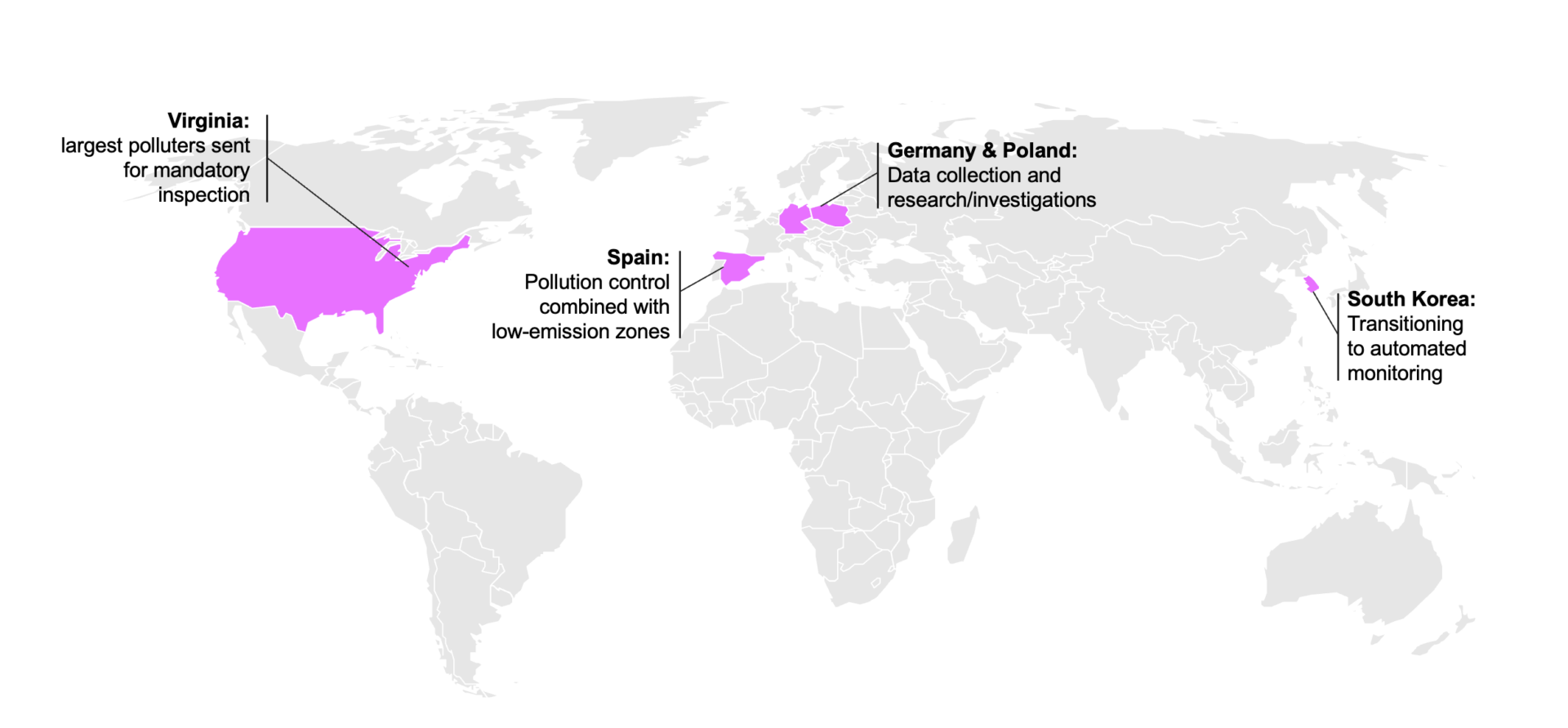
Civitta, together with JENOPTIK Baltic, carried out a feasibility study on real-time remote monitoring of road-vehicle emissions in Lithuania. The study benchmarked practices in several EU and non-EU countries, analysed available remote-sensing technologies and assessed Lithuania’s legal and institutional framework.
The project was structured in three phases:
- Phase 1: Assessment of international experience, market supply and Lithuania’s current vehicle-emissions control system
- Phase 2: Development of implementation alternatives and legal models
- Phase 3: Cost-benefit analysis and identification of required legislative changes
Civitta and its technical partners proposed high-emission threshold values for remote monitoring, compared the costs and benefits of three implementation options and proposed a three-stage rollout from a preventive model to automatic sanctions. The study also set out the legislative amendments needed to support the system.
During the project, the team designed the full operating model: institutional collaboration, data flows, IT integrations, legal changes, the metrological approval path and the sanctions framework.
Results & Impact:
The study concluded that Lithuania could check about 80% of its vehicle fleet and identify around 2% of the most polluting vehicles. Those vehicles would face sanctions and restrictions on road use. The estimated socio-economic effect would exceed EUR 600 million.
The project gave the Ministry a national roadmap for moving from manual, resource-intensive enforcement towards a data-driven, targeted and eventually automated pollution-control model.
Key Takeaways:
1. Remote emissions monitoring works best as part of a broader enforcement and governance system, not as a standalone technology purchase.
2. The strongest international models combine data collection, targeted inspections, institutional co-ordination and a gradual move towards enforcement as legal and metrological conditions mature.
3. The approach is applicable to other countries and cities considering low-emission zones, roadworthiness-enforcement reform, automated environmental monitoring or data-driven public-inspection models.