Final Evaluation of the Baltic Sea Region 2014-2020 Programme
Client
Läänemere piirkonna korraldusasutusThe Background:
The Interreg Baltic Sea Region (BSR) Programme is an EU-funded initiative integrating territorial development and cooperation to ensure a more innovative, accessible, and sustainable Baltic Sea Region. During the 2014–2020 funding period, the BSR Programme focused on innovation capacity, efficient management of natural resources, and sustainable transport.
Our team had the opportunity to assess whether and how the Interreg BSR Programme as a whole achieved its set objectives, what impact the programme had, and how the funded projects fulfilled their goals.
Project Content:
Interreg is a European Union cohesion policy instrument aimed at addressing cross-border challenges and jointly developing the potential of different territories to become greener, smarter, and better connected. The programme addresses risks and issues that a single country cannot resolve alone and where transnational cooperation is required.
The programme co-financed approximately 200 projects in the countries surrounding the Baltic Sea. Each project played an important role in making the region more innovative, sustainable, and accessible.
Our analysis shows that, despite the COVID-19 crisis, the programme achieved its objectives:
- Institutional capacity has improved since 2020, though progress could have been faster.
- Many organisations prefer to invest their knowledge, time, and financial resources in technological innovations, which creates a shortage of resources for other types of projects.
- A tailored approach should be applied to engage different target groups, so that project results reach them in the most appropriate way.
- Interventions need to be less concentrated in cities and more developed regions, with greater focus on engaging rural participants.
- “Project platforms” are a valuable tool for scaling up the impact of projects.
- Pooling different funding sources allowed problems to be approached from a broader perspective.
- The COVID-19 pandemic introduced restrictions that forced many activities and communications online. Online collaboration reduced cohesion, made cooperation more difficult, and negatively affected the development of networks with other projects or stakeholders. On the positive side, online events helped projects reach new and wider audiences, increasing their visibility.
Services Provided:
- Expert interviews with policymakers from Baltic Sea countries.
- An online questionnaire to collect input on performance indicators.
- A large-scale online survey among all project partners and beneficiaries to gather information on project results.
- In-depth interviews and focus group interviews to collect feedback on programme results and impact.
- Validation seminars to confirm findings and develop recommendations for planning future programmes and improving processes.
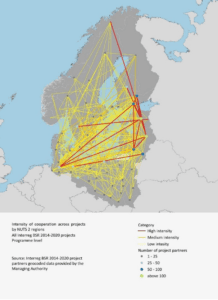
Intensity of Inter-Project Cooperation:
Results:
The Baltic Sea Region Programme successfully achieved its objectives despite the obstacles encountered. The final report assesses the programme’s progress in reaching performance indicator targets measuring the institutional capacity of target groups. Ultimately, the BSR experience provides valuable insights for planning and implementing future programmes in the region.