Akmenės Cementas: securing €30M from the EU Innovation Fund for green cement production
Client
AB Akmenės Cementas (Schwenk Group)Client Overview:
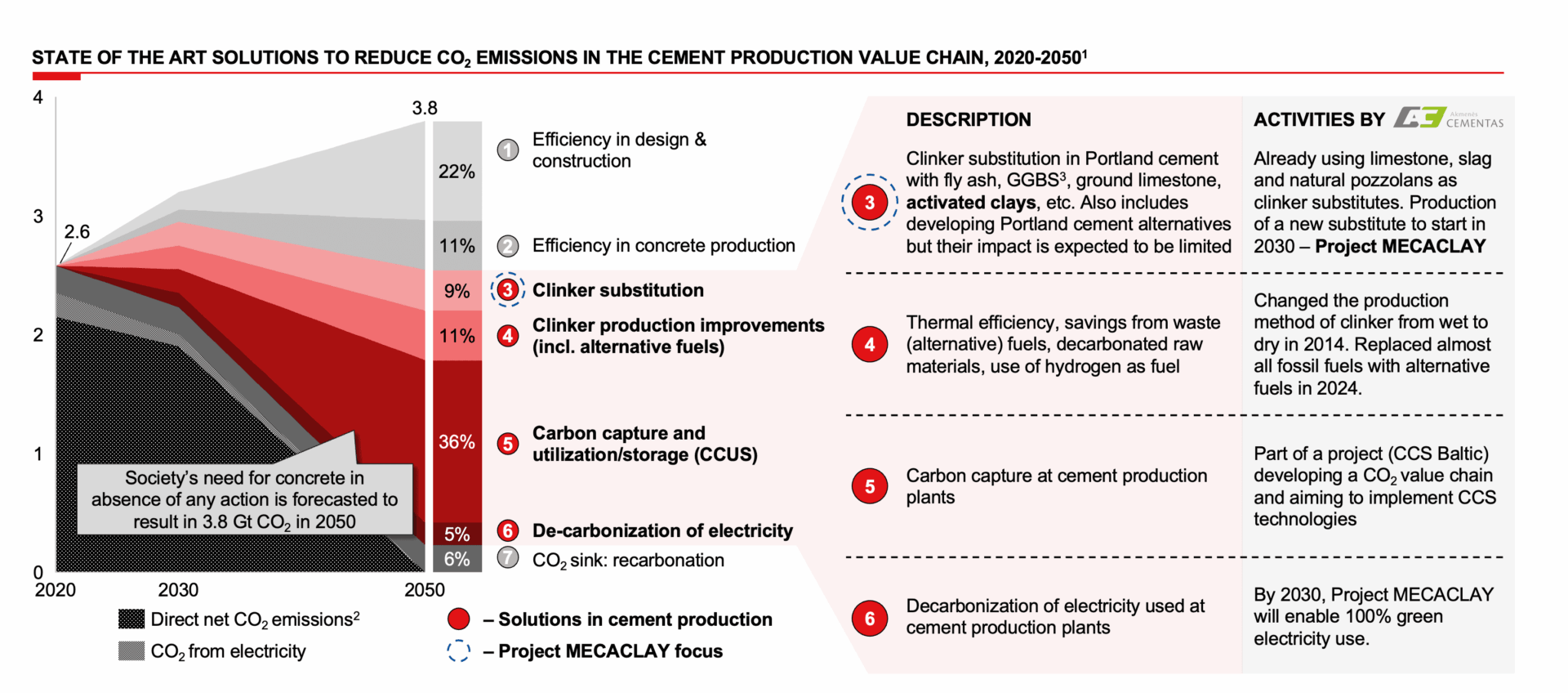
AB Akmenės Cementas, part of the Schwenk Group, is the only Lithuanian cement producer. The company has been actively investing in decarbonisation as part of group-wide commitment to reach CO2 neutrality by 2050.
The Challenge:
Schwenk’s R&D team developed MeCaClay, a mechanochemically activated clay that can replace much of the clinker used in cement production without weakening the material’s essential properties. The process also cuts a significant share of CO2 emissions.
Schwenk tested the technology on a limited scale at its Allmendingen plant in Germany. To scale it to industrial production in Lithuania, at 10x the pilot capacity, the company needed substantial investment and a sound funding strategy. It chose to apply to the Innovation Fund, which backs industrial trials of net-zero technologies.
Key challenges:
- Company developed an excellent technology but needed a “bankable” polish of industry-standart feasibility study and business plan
- A tight timeline to meet substantial Innovation Fund requirements on time required involved hands on work
Our Approach:
Civitta was engaged to lead the preparation of the Innovation Fund application. The work was done within the following phases:
Phase I: Validating the idea
Civitta and Akmenės Cementas aligned on the project’s storyline and scope through a structured kick-off process, including GHG emissions calculations and cost analysis to confirm the project could deliver sufficient emissions reduction and qualify for a competitive grant amount.
Phase II: Preparing the application
Civitta ran structured work seminars covering each section of the application and its mandatory annexes, combining independent desk research with the client’s technical input.
Each proposal section was drafted, reviewed with the client and revised based on feedback: a closely coordinated process with clearly divided responsibilities between the Civitta team and Akmenės Cementas’ technical experts.
Phase III: Submission
Civitta prepared the submission system and administrative forms, uploaded all documentation and carried out a final review before submission, ensuring the application was complete and consistent across all sections.
Results & Impact:
The MECACLAY project was successfully awarded EUR 29,580,000 from the EU Innovation Fund under the InnovFund-2024-NZT call.
The project is expected to save more than 1.9 million tonnes of CO2 equivalent over ten years of operation. Beyond emissions reduction, the project is expected to create lasting economic value for the Akmenė district and Šiauliai region, generating permanent jobs in engineering, production and sustainability management, and strengthening local supply chains.

Key Takeaways:
- Unproven technology needs a credible scale-up story: because MeCaClay had only been tested at pilot scale, Civitta built a narrative that showed evaluators exactly why a 10x jump in production was low-risk and well-planned.
- Technical credibility matters as much as the writing: Civitta’s prior experience assessing Innovation Fund proposals for the European Commission gave the team direct insight into what evaluators look for – insight that shaped every section of the proposal.